

Put a Pike in it: Vlad III
Dracula and the delicate art of impaling your enemy
Written by Kelsey Lescop
In 1452 or 1453, Vlad III Dracula was travelling through Transylvania when he was ambushed and nearly killed. Four years earlier, he had briefly been a prince. Now he was an exile, pursued by assassins and forced to beg for aid from the man who had murdered his father.
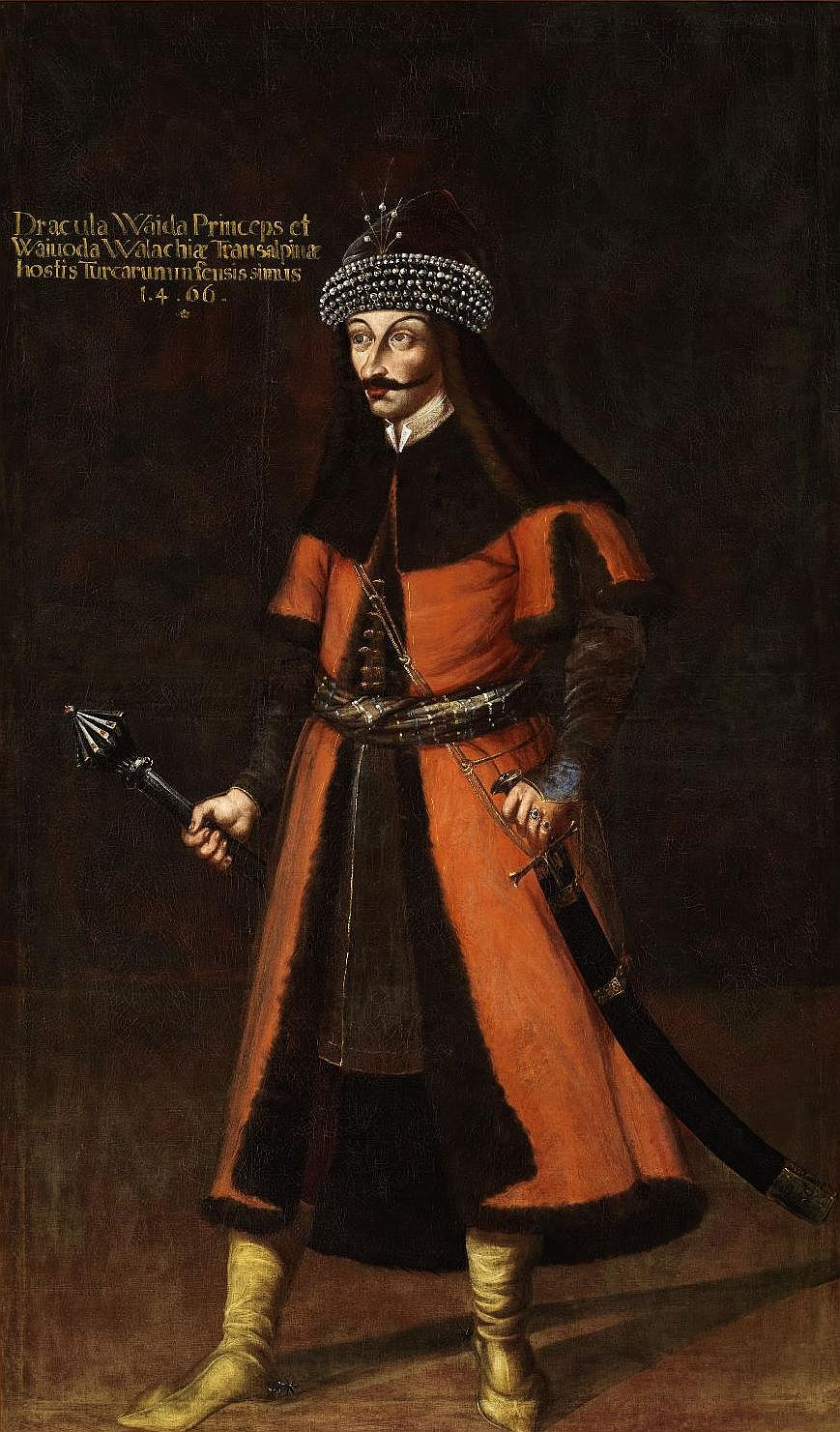
A 17th century portrait of Vlad with his distinctive pearl crown. Note the tunic, sword, boots are in the style of steppe cultures. Vlad adopted similar Ottoman-style clothing at his coronation.
Portrait of Vlad Țepeș," 17th-century oil on canvas, anonymous artist. Located in the Esterházy Ahnengalerie, Burg Forchtenstein, Forchtenstein, Austria.
Most of Vlad’s life had been in exile. His father Vlad II Dracul was hiding out in Transylvania, then a part of the Kingdom of Hungary, when Vlad entered the world sometime in 1429-1430. Indeed, exile was something of a family tradition. Vlad descended from the voivodes, or princes, of Wallachia, a border principality between the expanding Ottoman Empire to the south and the chaotic Hungarian kingdom to the north. The pressures of these two great powers meant that Wallachian princes rarely lasted very long and spent much of their reigns fending off challenges from ambitious relatives.
Exile could also be a stepping stone to power. In 1431,Vlad’s father was invited to the court of the Holy Roman Emperor Sigismund I and, in an elaborate ceremony, inducted into the chivalric Order of the Dragon. This was a great honor for the family, and Vlad III would later style himself Dracula, or “son of the dragon.”
In 1436, when Vlad was about seven years old, his father took the throne of Wallachia. Vlad would spend the next eight years at the capital of Târgoviște. While not much is known directly about Vlad’s adolescence, he would have been given a trusted older lord as a tutor and received training in horseback riding, jousting, and the Wallachian recurve bow.
At the age of 14 or 15, his father traded him and his brother Radu as hostages to the Ottomans to conclude a peace deal. Vlad would spend the next four years as a prisoner and would never see his father again. However, he learned the Turks’ language and manners during his captivity, which he would use against them later.
In late 1447, a monetary dispute between Vlad II and John Hunyadi, the regent and de facto ruler of Hungary, turned violent. Hunyadi invaded Wallachia and in a matter of a few weeks had Vlad II executed and replaced him with a more pliable relative, Vladislav II. When Vladislav was called to war against the Ottomans in Kosovo the next year, Vlad Dracula seized the opportunity. With the support of the sultan, Vlad led an Ottoman force into Wallachia and took the throne for the first time, but was almost immediately deposed when Vladislav rushed home with his army.
Dracula fled to his relatives in Moldavia, but when his protector Prince Bogdan II was ripped out of bed and decapitated after a wedding party in 1451, Vlad fled to the relative safety of Transylvania.
But Transylvania was no refuge for Vlad. John Hunyadi wanted nothing to do with him, and certain local burghers were loyal to Vladislav. And so, somewhere near the town of Geoagiu, two of Hunyadi’s followers attempted to murder Vlad, but he survived the ambush. Over the coming years he made peace with Hunyadi while the relationship between the regent and Vladislav II soured.
On June 8th 1456, Halley’s comet, a medieval portent of dramatic change, would appear in the sky for several weeks. When John Hunyadi died suddenly of plague, Vlad jumped on the opportunity to invade Wallachia while there was nobody to stop him. With the help of a cabal of nobles, Dracula defeated, captured, and beheaded Vladislav in just over a week. Vlad Dracula was finally crowned as the prince of Wallachia.
To Reign and Govern Accordingly
The first half of Vlad’s reign was marked by a struggle with the Transylvanian Saxons of the cities of Sibiu and Brașov. The burghers of these towns were harboring rival claimants to the Wallachian throne, and Vlad had tried on multiple occasions to have the pretenders expelled through diplomacy. In one letter to the burghers of Sibiu, he threatens that if they fail to respond, he will “know very well how to reign and govern accordingly.”
In March 1457, Vlad attacked. A contemporary source states that Vlad had castles and villages “burned to ashes…the men, women and children, large and small, whom he did not immediately burn, he brought with him to Wallachia bound in chains and had them all impaled.” The raid failed, however, to capture the two pretenders.
Two years later, Vlad turned his wrath on Wallachian nobles who he suspected of plotting against him. Some accounts claim that he had five hundred boyars impaled during an Easter banquet after they failed to correctly answer a riddle. While these versions are most certainly exaggerated, documentary evidence does support the theory of an extensive purge in the nobility, and it's possible that Vlad could have impaled around fifty boyars in a single event around this time.
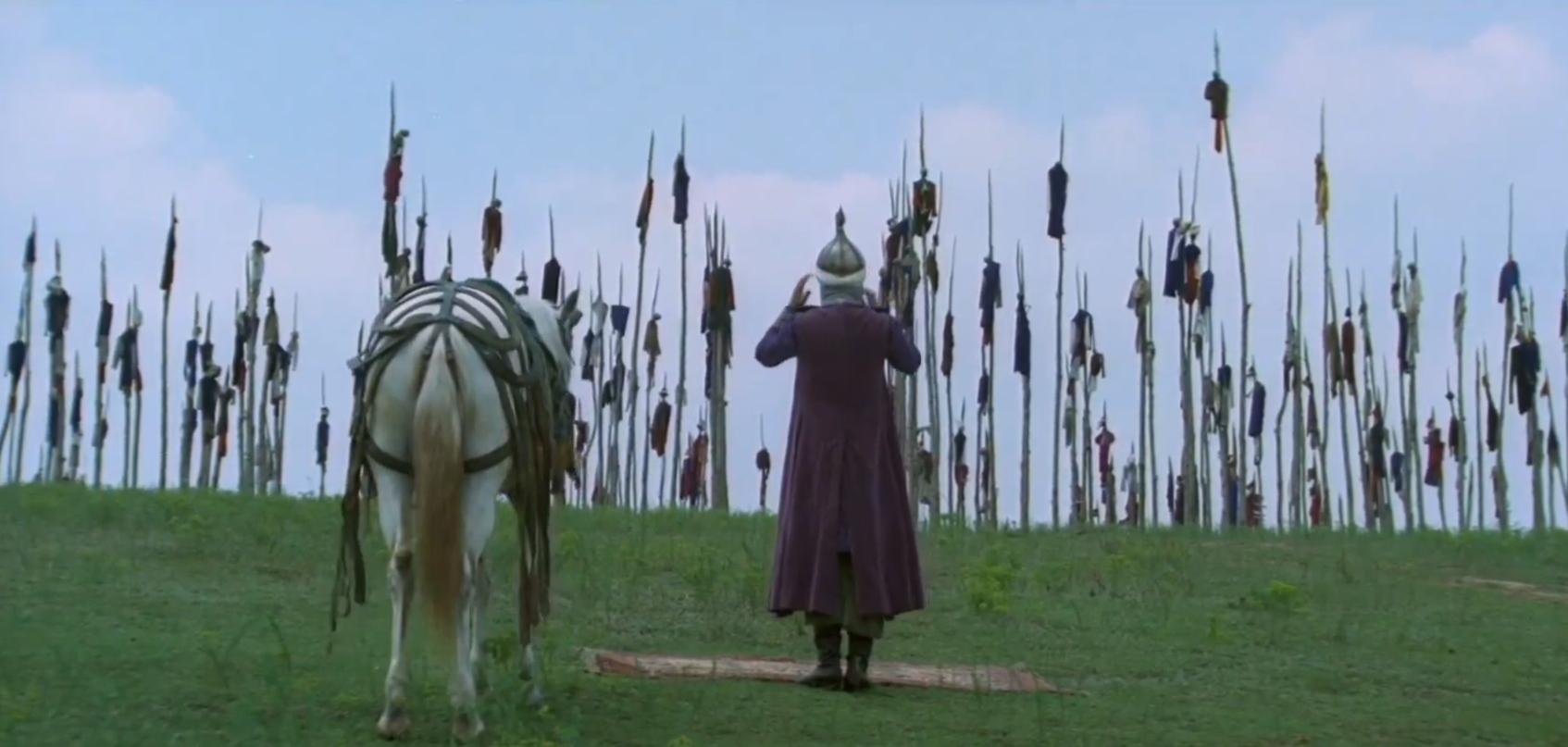
Sultan Mehmed II beholds Vlad’s work. From the film Vlad Țepeș (1979)
Still from Vlad Țepeș (1979), directed by Doru Năstase. Production: Casa de Filme.
Despite Vlad’s efforts, one of the pretenders, Dan III, made his move in the spring of 1460. Before leaving from Brașov, he issued a charter reflecting on “the enormous injustices; the irreparable losses; the miserable slaughter, mutilations, [and] torments with which the proved and honest men…of Brașov…have been afflicted…by the impious, most cruel and faithless tyrant, namely Dracul, the so-called Vlad.”
Dan crossed into Wallachian during Easter of 1460, but in just over a week his army was crushed and Dan was captured and decapitated. A letter from that month claims that “Dracula ordered the impalement of [Dan’s] men who had fallen in battle. And also the women he was able to catch have also been impaled, with their infants attached to their breasts.”
In the wake of this failure, the burghers of Sibiu and Brașov and the Hungarian king sent a peace embassy, but Vlad had other ideas for now. “Dracula let these lords wait about five weeks, and had stakes made before their lodgings. They thought they would be impaled.” Vlad attacked the villages and castles that had supported Dan, burning crops, churches, castles and towns, seizing grain, goods and even church vestments, and impaling liberally. Once he was done, he returned home and concluded a peace deal with the detained emissaries.
Breaking the Peace
For all its brutality, Vlad’s successful defense of his throne had a positive impact on his relationship with the Hungarian crown. Matthias Corvinus, the new Hungarian king, offered Vlad a marriage alliance. However, this alliance was unacceptable to the Ottoman sultan, who was already frustrated by Vlad’s failure to pay tribute for the last two years. So the sultan laid a trap for Vlad. In early 1462, he sent an emissary promising that if Vlad came to Constantinople to pay the owed tribute, he would be given safe passage. However, the emissary was part of a kidnapping plot which Vlad fought off and reversed, taking his would-be kidnappers prisoner. Perhaps unsurprisingly, they were mutilated and then impaled.
Vlad then struck hard at the Ottomans. In a series of raids and surprise attacks, Vlad attacked and destroyed forts, harbors, towns and river crossings along almost the entire Danube river bordering the Turks. In a letter by him to King Matthias he gives a long accounting of each town and how many people he killed there. He tallies a total of 22,883 killed, “without counting those burned alive in their houses, or whose heads were not presented to our officers.” At the end of this list, he writes “in the aforementioned places…the inhabitants—men and women, youth, little children together with babies—were killed and the area was destroyed.”
The Ottomans immediately assembled an army of some 60,000-80,000 soldiers, the largest since the capture of Constantinople in 1453. Vlad appealed to the Hungarian king for support, but when the Ottoman army arrived at the border of Wallachia in the summer of 1462, he stood alone with his army of around 25,000 Wallachians,
Dracula sought to prevent the massive Turkish army from crossing the Danube at Nicopolis. The Turks crossed at night and drifted across the river so as to not make noise, but when they began to dig in on the Wallachian side, Dracula opened fire on them with cannons and killed two hundred and fifty elite janissaries. When the sultan returned fire with his own cannons, Vlad was forced to withdraw.
The Ottoman campaign was a difficult one. One witness wrote that the heat was so intense that the “cavalry could have grilled kebabs with their armor.” Vlad, unable to fight the Ottomans in a pitched battle, opted for harassment and skirmishing, culminating in the legendary night raid on the Ottoman camp outside Târgoviște.
Possibly disguising himself as a Turkish merchant and spying on the camp himself, Dracula identified the tents of the sultan and his chief generals. He came back that night with a detachment of 7,000 to 10,000 soldiers and attacked the camp “with torches ablaze and horns resounding” They fought towards the sultan’s tent, but in the furor of battle, they attacked the wrong tents. With the element of surprise lost, Vlad withdrew from the camp and his army melted away into the forest.
When the Ottomans finally approached the Wallachian capital, they came upon Vlad’s grotesque magnum opus. The Greek historian Chalkokondyles, who worked during Vlad’s lifetime and was in the inner circle of Ottoman leadership, wrote:
“The sultan’s army entered into the area of the impalements which was [three kilometers long and one kilometer wide]. There were large stakes there on which, as it was said, about twenty thousand men, women, and children had been spitted…The sultan was seized with amazement and said that it was not possible to deprive of his country a man who had done such great deeds, who had such a diabolical understanding of how to govern his realm and its people. And he said that a man who had done such things was worth much. The rest of the Turks were dumbfounded when they saw the multitude of men on the stakes. There were infants too affixed to their mothers on the stakes, and birds had made their nests in their entrails.”
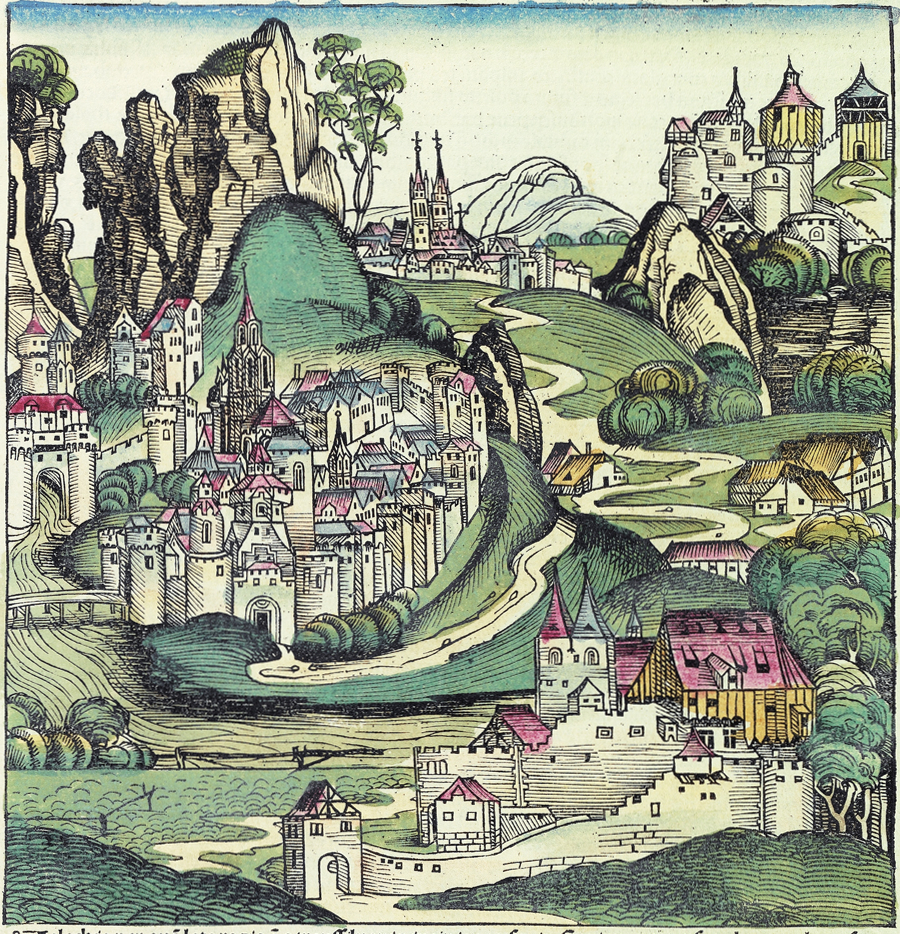
A 15th century woodcut illustration of Wallachia from the Nuremberg Chronicle
"Walachia," woodcut illustration from the Nuremberg Chronicle (Latin edition, 1493) by Hartmann Schedel, with woodcuts by Michael Wolgemut and Wilhelm Pleydenwurff. Held in the Rare Books Collection of the University of São Paulo, São Paulo, Brazil.
Vlad’s skirmishing could not stop the sultan’s army, but neither could the sultan defeat Dracula, who continued to harass the Ottomans as they withdrew. In the end it was a betrayal by the Hungarian king that sealed his fate. Dracula met with King Matthias in Brașov to coordinate support for recapturing Wallachia after the Ottoman withdrawal. Instead, Corvinus arrested Dracula and, using forged letters that purported to show a secret alliance between Vlad and the Ottomans, imprisoned him in a Hungarian fortress.
After thirteen years in Hungarian custody, Vlad would eventually be allowed by Matthias to invade Wallachia and retake the throne, but like so many attempts by pretenders, this ended quickly and violently. Accounts of his death usually involve some betrayal or confusion that resulted in Vlad’s being killed by one of his own men. In any case, his head was cut off, the skin of his face and scalp were “embalmed and stuffed with cotton, following a customary Turkish method,” and presented to the sultan.
It is tempting to dismiss the stories of Vlad’s exploits as myth or exaggerations, and many stories exist of Vlad torturing animals while in prison or eating lunch among forests of impaled corpses. These often have that fantastically gruesome quality that arouses suspicion. And yet, a wealth of sources from a variety of backgrounds, including Vlad’s own accounts, support the view that in the pursuit of gaining and maintaining power, he committed such brutal acts of violence, that even to the medieval observer, used to the cruelties of war, he was something of a monster. An appropriate inspiration no doubt, and in some ways more horrifying, than the undead vampire that bears his name.
Kelsey is an investigative Journalist, trained at the University of Gothenburg. Raised in New York, she resides in Paris and has had a lifelong interest in medieval history: kelseylescop.com.
Further Reading
Cazacu, Matei. Dracula. Edited by Stephen W. Reinert, translated by Nicole Mordarski et al., Brill, 2017.
Treptow, Kurt W. Vlad III Dracula: The Life and Times of the Historical Dracula. Center of Romanian Studies, 2000.