

Salt & Sea: Part I - The Early Medieval Maritime World
Written by Tyler Batstone
When we tell the tales and stories of the Middle Ages, we often find ourselves describing the dramatic events that happen on land with battles, royal successions, rebellions, and usurpations. However, the medieval world existed beyond the trappings of the earth with various groups, cultures, kingdoms, empires, and independent entities travelling the seas across Eurasia for trade, war, conquest, and piracy. In the Middle Ages, power over the sea was just as important as power over the land and those who controlled the tides were able to grow flourishing wealth in kingdoms and thalassocratic (maritime) empires. In this two-part article we will explore how these nautical cultures of coastal communities and maritime societies became the political and economic powerhouses of empires that dominated the oceans of the world in the Early Modern Era. So welcome aboard and let us set sail into the Early Middle Ages where our setting begins.
The Early Medieval World and the Sea
From the ashes of Antiquity, the Middle Ages burned bright when it came to revolutionizing maritime travel and trade across Europe. The two seas of northern and southern Europe, the North and Mediterranean seas, became the two most premiere settings for maritime travel and trade during the Early Middle Ages. The Migration Period saw an influx of Germanic tribes expand and occupy much of western Europe following the collapse of the Roman Empire, many of which adapted to their newly founded coastal homes against the seas and built vessels that braved the North Sea. Archaeological excavations of burial sites dated to the Vendel Period indicate that ships were valued in both life and death in Northern Germanic societies before the Viking Age as evidenced by examples such as Sutton Hoo in England, Uppsala in Sweden, and the Valsgärde Boat Graves in Uppland, Sweden.
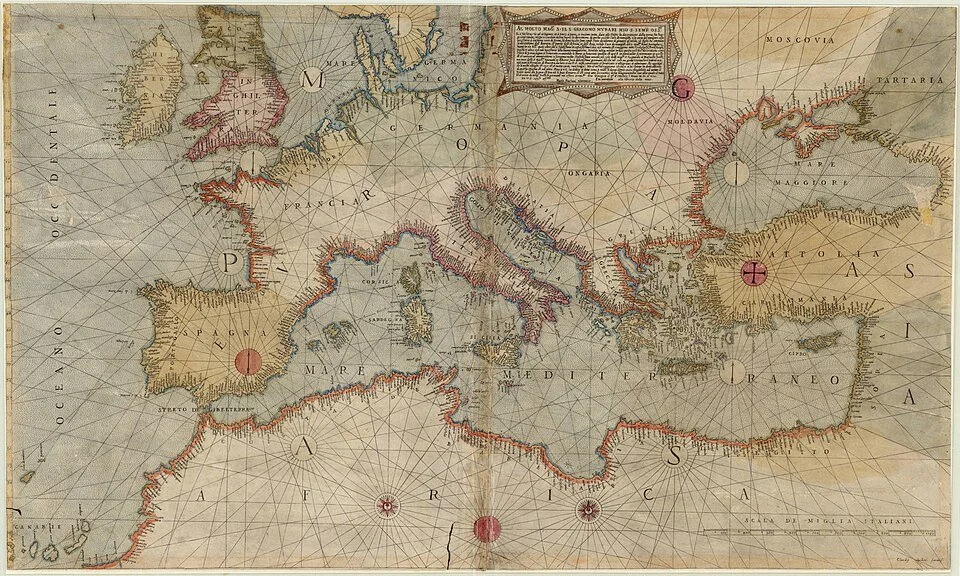
Map of the Mediterranean
In southern Europe, the Mediterranean was splintered and contested by various factions of empires, kingdoms, and young caliphates. The Byzantine Empire controlled the majority of the Aegean Sea since their western counterpart evolved into the kingdoms of Lombardy and Italy. As it was in Antiquity, the Mediterranean was the central hub of the Eurasian world when it came to trade, commerce, and cultural exchange as it connected Europe, Asia, and Africa by its borders. This made the seas highly contested between various factions vying for power on the high seas such as the Byzantine Empire, the Rashidun, Umayyud, and Abbasid Caliphates, the Ostrogothic Kingdom of Italy, and the young up-start thalassocratic republics of Venice and Genoa.
Early Medieval ship types
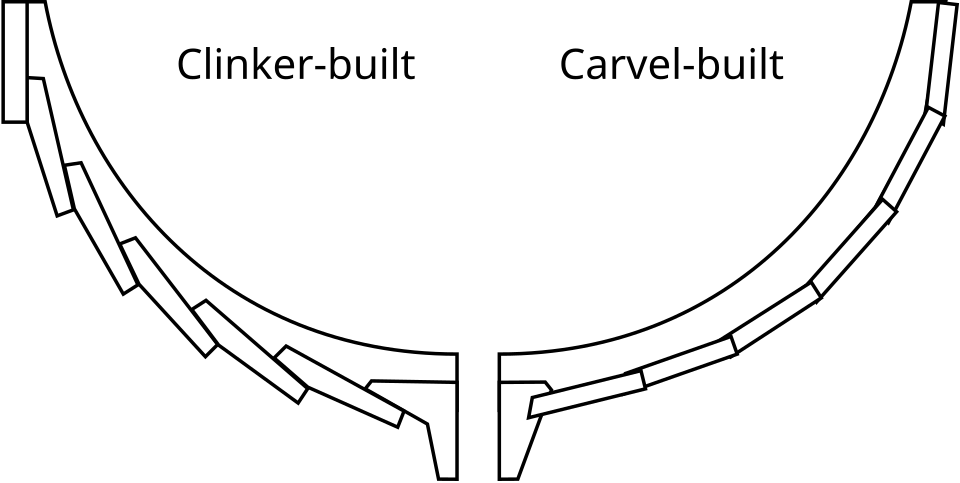
The sea born vessels in which early medieval peoples traveled on varied depending on their region. In northern Europe, the longship was favored for its clinker-built hull which employed the concept of overlaying the planks of the hull so that the bow of the ship had an easier time cutting through the rough waves of the North. Southern Europe inherited the Galley, an oared ship equipped with two masts and two sails that was built utilizing the carvel technique which employed the planks of the hull to be flushed with one another which was the orthodox method of shipbuilding and hull-fasting. Both of these ship types in the Early Middle Ages were manually oared by rowers when navigating rough conditions but where the longship was equipped with a single mast with a sail during favorable winds, the galley was typically larger than that of the Northern Longship due to the warring tendency of the Mediterranean itself compared to the North and Baltic Seas. Galley warships such as the Dromon were large vessels built especially during times of large-scale naval warfare and allowed for both sea battle and troop transport across the Mediterranean.
Early Medieval Navigational Technology
While new shipbuilding techniques sought ways to travel through rougher waters, sailors and navigators sought new inventions that would help guide their way on voyages and long trips across the seas. The most basic and rudimentary navigational skill that sailors have used since their conception has been navigating waters via the stars overhead at night. Constellations and celestial navigation were used to determine latitude from the sailor’s current position. During night, constellations such as Polaris (the North Star), Crux (the Southern Cross), and the Ursa major and minor (the big and little dipper), were utilized to help locate cardinal directions while at sea. Cabotage was a navigational technique that involved sailing along the coastline instead of being out in open water to reach your destination, this was due to the fact that many early medieval ships were not typically suitable for open sea travel due to the unpredictability of the ocean and the chance of being pushed off-course or becalmed which was a risk that no sailor or captain was willing to take. With land in constant sight, this allowed them to follow the geography right to their intended ports and havens.
The Astrolabe was created by Arab mathematician Muhammad al-Fazari in the 8th century and became the first navigational instrument to use angles and azimuths to help decipher mapping of the stars through astronomy. This device was also able to predict time and the rotations of the sun which helped sailors to determine the latitude of their intended course. In Northern Europe, Scandinavian sailors are said to have developed a device known as a Sunstone which was used to locate the position of the sun in times of overcast weather, however the historical basis of this instrument is hotly debated, with literary attestations coming only from the 13th and 14th centuries. The Kamal was created by Arab sailors in the 9th century; it consisted of a string with several knots tied to a wooden board that was used to measure latitude. This device was soon adopted by Indian sailors and later Chinese navigators by the Late Middle Ages.
The Vikings
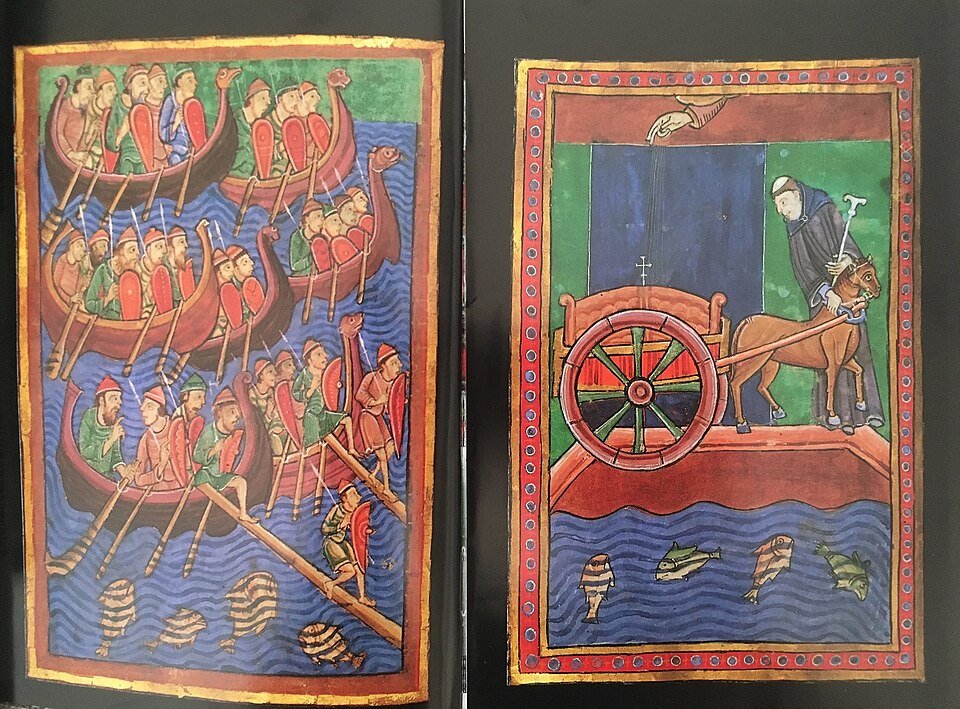
Invasion of England by Ivar the Boneless in 886. Illuminations of an English history of the 11th century. Pierpont Morgan Library, New York.
In 793 AD, a monastery in England was attacked by raiders who were described as ‘godless heathens', these people would eventually be known as ‘Danes’ or as our modern world knows them as, ‘Vikings’. In the aftermath of the raid on Lindisfarne Monastery, more Viking attacks and raids spread out over Europe like an unquenchable fire and soon started to represent an epidemic of attacks across the continent. From England to France and the Iberian Peninsula, the Vikings sailed and traveled wide and far from their homeland of Scandinavia in Northern Europe. Aside from raiding via their travels, the Vikings also set up multiple trade networks across the North and Mediterranean seas that inevitably became one large trade network that connected both northern, western, southern, and eastern Europe all by waterways for trade goods such as silver, silks from the far east, rare furs, exotic foods, textiles and precious metals. The most lucrative and common trade practice by the Vikings however was slavery, as the Viking Slave Trade of the Early Middle Ages was one of the largest slave trade networks Europe had seen since Rome.
Often called thralls in old Norse, slaves in Scandinavian society were viewed as subhuman individuals who did not have any rights by Scandinavian society standards. Often enough, slaves were put to hard labour on the farms and estates of wealthy landowners and the nobility. Vikings would capture individuals across Eurasia during their raids and sell them at various slave ports and auctions abroad such as Kyiv and Constantinople. Aside from being lucrative traders, warriors and raiders, Vikings were also competent and successful explorers by creating settlements in Islands on the fringes of their world such as Iceland, Greenland, and the fabled Vinland of North America. By the 10th century, they had mostly integrated themselves in Christian society which allowed them to continue trading with other Christian kingdoms.
The Byzantine & Arab Mediterranean
When the Roman Empire was at its height, it controlled all of the Mediterranean through trade and naval power, but when the western half fell, the remaining eastern half (also known as Byzantium) was only able to control the eastern Mediterranean due to the limit of their borders. The Byzantine Navy was the fiercest and most powerful navy in the Early Medieval world; their fleet consisted of hundreds of galleys and dromons. By the mid-7th century, the Muslim conquest of Syria and Egypt posed new threats to the empire’s eastern borders. The Muslims began creating a navy of their own, building ships based off the galley design via Palestinian shipwrights and mimicking Byzantine naval tactics which leveled the playing field for both armies.
In the aftermath of the Muslim conquests during the early 9th century, a group of exiles of Andalusia sailed from Spain to the island of Crete in the Mediterranean where they established a Islamic settlement and declared themselves an independent state. After swearing allegiance to the Abbasid Caliphate, the island became a base from which naval raids were launched against the Byzantine navy and merchant ships in the Mediterranean, leading many to label Crete at this time as a pirate island. It wasn’t until the mid-10th century that Byzantine Emperor, Romanos II resolved to stamp out the piracy in Crete and sent a large force to take back the island from pirate control. After a long siege, the Byzantines broke through the island fortifications and slaughtered or enslaved the Muslim inhabitants.
War on the Sea in the Early Middle Ages
While most battles in the Early Middle Ages were fought on land, some were located on the tides of the sea as well although quite rare compared to the Late Middle Ages and Early Modern period. The Mediterranean saw the majority of these battles due to the constant wars between Byzantium and other factions warring over control of the sea. The tactics used during the theater of the Aegean were inherited by the Romans who originally rarely utilized naval combat with their ships. As seen in Antiquity and the beginning of the Early Middle Ages, ships were typically used for troop transport and almost all of the fighting was done on land due to Rome holding a monopoly on the Mediterranean. However, when the western empire collapsed new political factions such as the Arabs to the east and the Ostrogoths to the west began to contest Byzantium for supreme control over the sea. Byzantine warships and galleys were equipped with rams at the bows which was an integral part to Byzantine naval strategy and tactics.
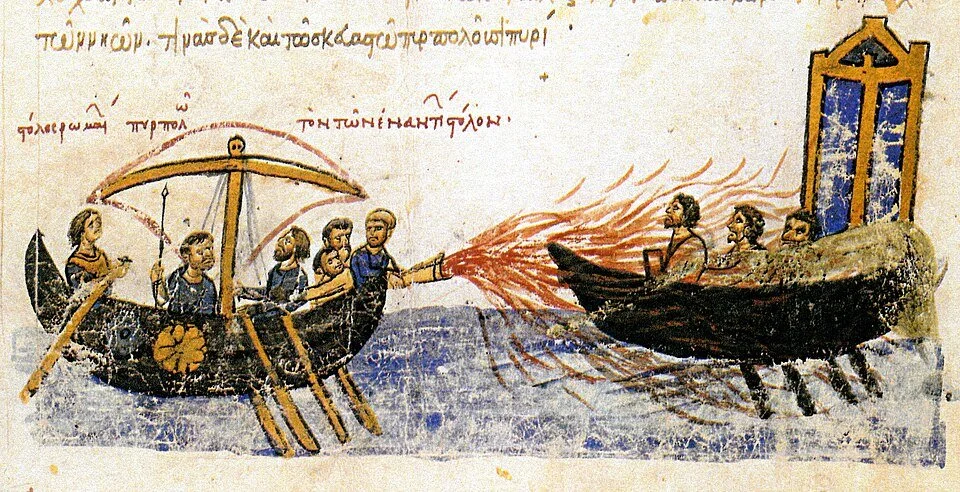
A depiction of Greek Fire
At the Battle of the Masts in 655 AD, the Byzantine and Arab fleets clashed together near the coast of Mount Phoenix where the seas were so rough that the ships became pushed together, creating an opportunity for hand-to-hand combat across the decks of the vessels. The Arabs won the battle that day and set the stage for the First Siege of Constantinople in 674 AD which saw the first use of Greek fire by the Byzantines to defeat and destroy the Arab fleet and end the siege. While there was a great deal of fighting in the Mediterranean there were a few battles fought in the North and Baltic seas, such as the Battle of Hafrsfjord in 872 AD which was the last battle that Harald Fairhair had before uniting all of Norway under his rule as king.
Another northern battle, the Battle of Svolder in 1000 AD saw the use of naval tactics for longship warfare as utilized by both sides during the fighting. While sailing near the coast of Wendland for a campaign, King Olaf Tryggvason of Norway and his fleet were ambushed by a coalition of Danish and Swedish ships led by King Svein Forkbeard of Denmark, King Olof Skötkonung of Sweden, and Jarl Eirik Hákonarson of Lade.
The North Sea Empire
In 1013 AD, King Svein Forkbeard of Denmark conquered England and adopted it as part of his North Sea Empire, joining his rule in other northern kingdoms such as Norway and Denmark. After his death, his sons inherited the many kingdoms that once made up the empire but one son in particular sought to reunite all former lands and territories under one ruler. Cnut the Great had already inherited the kingdom of England from his father, and from there he sought to reclaim the thrones and crowns of Norway, Denmark, and Sweden for himself. By 1030 AD, Cnut regained the kingdoms of his father’s empire and ruled them all under his kingship. The North Sea Empire, being mainly a thalassocratic state, depended much upon the maritime trade between the northern kingdoms with a majority of the silver and coinage coming from England while Norway, Denmark, and Sweden supplied timber for shipbuilding and other rare northern commodities such as ivory, iron, and exotic furs. Unifying the kingdoms around the North Sea also allowed for safer trade routes going to and from the north which allowed merchants and sailors to make their voyages unharassed by pirates or independent kingdoms. However, Cnut’s death in 1035 AD deeply unstabilized the empire leading to its fracturing and downfall by his sons who were all eager to succeed him as ruler of the northern kingdoms.
On the Horizon
The second half of the 11th century and beyond into the High and Late Middle Ages marked a drastic change in maritime trade, social relations, navigational technology, new powers commanding the seas, war and ship types, and the borders of kingdoms and empires extending into the waters around their coasts. In the second part of this article, we will explore these changes and how they affected the medieval world as a whole from the Crusades, to the wars between Venice and Genoa, piracy in the Baltic Sea, the Hundred Years War and the rise of privateering, and finally the exploration efforts of Spain and Portugal that inevitably led to the colonization of the Caribbean in the West Indies.
You can see more of Tyler’s work by visiting his Instagram : @medievalbatstone
Further Reading
Guy Ropars, Gabriel Gorre, Albert Le Floch, Jay Enoch, Vasudevan Lakshminarayanan; A depolarizer as a possible precise sunstone for Viking navigation by polarized skylight. Proc. A 1 March 2012; 468 (2139): 671–684. https://doi.org/10.1098/rspa.2011.0369
Richard Nelson Frye. 1975. The Golden Age of Persia.
Stenton, Frank M. 1970. Anglo-Saxon England. OUP Oxford.
Paine, Lincoln. 2015. The Sea and Civilization : A Maritime History of the World. New York: Vintage Books.
“The Early Medieval - a Maritime Archaeological Research Agenda for England.” 2022. A Maritime Archaeological Research Agenda for England. March 24, 2022. https://researchframeworks.org/maritime/early-medieval-ad-400-to-1000/#section-1.
Watts, Paul. 2025. “Life at Sea in the Middle Ages - Medieval History.” Medieval History. January 10, 2025. https://medievalhistory.info/life-at-sea-in-the-middle-ages/.
Friel, Ian. 2012. “Ships and Seafaring.” Oxford Bibliographies Online Datasets, April. https://doi.org/10.1093/obo/9780195396584-0050.
“Warfare, State and Society in the Byzantine World, 565-1204 : Haldon, John F : Free Download, Borrow, and Streaming : Internet Archive.” 2025. Internet Archive. 2025. https://archive.org/details/warfarestatesoci0000hald/.
“Soga Um Harald Haarfagre – Heimskringla.no.” 2020. Heimskringla.no. 2020. https://heimskringla.no/wiki/Soga_um_Harald_Haarfagre.