

The Nine Herbs Charm:
Beliefs that Endured from Antiquity to Christianity
Written by Adam Staten
‘A worm cam sneaking. He killed no one. Then Woden took nine glory-twigs, struck the serpent, that he flew into nine parts.’
So begins one of the final passages in a truly enigmatic piece of Old English writing. The piece, usually known as ‘The Nine Herbs Charm’, is part poetry, part prose and is found in a single manuscript known as ‘The Lacnunga’ that is held in the British Library.
The manuscript is dated to the 9th or 10th Century which is well into the Christian era of Anglo-Saxon England and yet the poem still talks of the old pagan god, Woden. What is more surprising is that just a few lines later, it also talks about Christ.
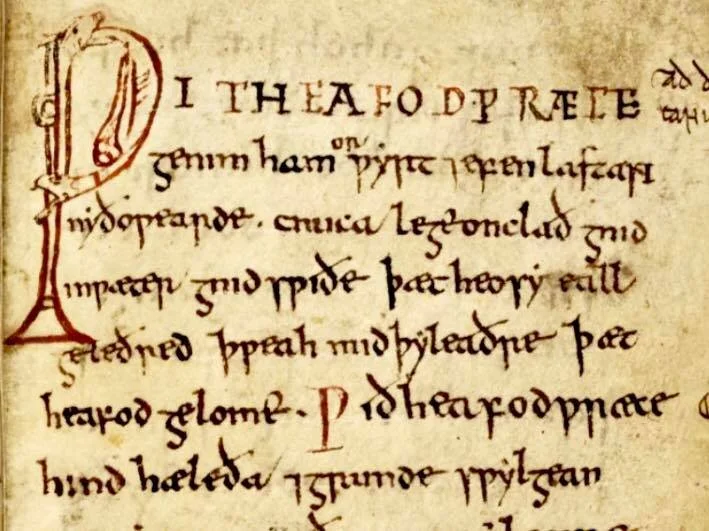
The Nine Herbs Charm
This mysterious piece of writing gives us tantalising clues about the evolution of beliefs around healing, religion, and spirituality during this period and reveals to us a belief system that is perhaps much messier than a simple dichotomy between Christianity and paganism.
The charm addresses each of the nine in turn. For example, to waybread:
And you, Waybread, plant-mother!
You’re open to the east, yet mighty within:
Carts creaked over you, women rode over you,
over you brides bellowed, over you bulls snorted!
You withstood it all—and you pushed back:
You withstood venom, you withstood air-illness,
you withstood the horror who travels over land.
The repeated use of the number nine is typical of other sacred Germanic texts. In the charm we have ‘nine herbs’, ‘nine venoms’, and Woden uses ‘nine glory-sticks’ to smite the worm into ‘nine parts’. The number nine was a sacred number in ancient Germanic tradition and is found throughout other old German writing. The reverence of the number nine seems therefore to be something that the Anglo-Saxons brought with them from their countries of origin. It is hypothesised that the number was sacred due to its connection with the lunar calendar, or perhaps it is related to the nine-month gestation of babies, although the real reason for its importance is yet another mystery.
The animistic way in which the charm speaks to the herbs concords with evidence from other medieval herbals in which Earth is perceived as the mother of all things, and herb gatherers should ask her permission before taking anything from her. This type of belief goes back to pre-Hellenic times and passes down to medieval Europe via the ancient Greeks and Romans. As such, it is deeply rooted in old, pagan beliefs.
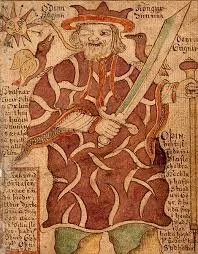
A Norse mythology image from an 18th century Icelandic manuscript
Even more surprising are links that can be found with ancient Indian scriptures – the Vedas that would ultimately form the basis for Hinduism. The poem talks of wyrms (worms) and is part of a wider Germanic tradition of ‘worm-charms’ in which worms are used to characterise illness and disease. This same habit is present in the Vedas. This means that this belief likely originates far back into pre-history, to the Proto-Indo-European people who were the ancestors of all the people who would eventually speak the languages of both Europe and the Indian sub-continent.
This suggests that the charm, in one form or another, had passed from one healer to another for thousands of years. Eventually, the charm encountered Christianity.
With the death of King Arwald on the Isle of Wight in 686 AD, the whole of Anglo-Saxon England had, in theory, converted to Christianity. Yet, about three hundred years later, we still find this charm – with its talk of Woden and plentiful pagan imagery - being included within the pages of a valuable manuscript. This certainly suggests that the break with the old beliefs was not sudden.
The connection between Christ and Woden is not as difficult to make as you may first assume. Not only was Woden, like Christ, associated with healing, but one of the stories associated with him is that he was hung from a tree, pierced in the side with a spear and, through this suffering, learned the knowledge of the runic alphabet.
The poem specifically mentions Woden and Christ but also ‘the hanging lord’ in the heavens which could be either. It may be that the author of the charm saw the two figures as essentially interchangeable. Such syncretic beliefs are seen elsewhere in Germanic writings of this period and seem to show a gradual fading of pagan traditions as those of Christianity gain strength rather than a sharp transition from one belief system to the other.
This one, strange piece of writing tells us so much about beliefs that endured, and about healing knowledge that was passed from person to person over thousands of years. Yet, equally, it leaves us forever wondering about the person or people who composed it, what they actually believed and how they practised these beliefs.
References
Banham, D., (2009). The Old English Nine Herbs Charm. In: M. Rubin ed. Medieval Christianity in practice. Princeton: Princeton University Press. pp. 189-193.
Hopkins, J. S., (2020). Nigon wyrta galdor, popularly known as the Nine Herbs Charm: a new annotated and illustrated translation. [online] Available at: https://www.mimisbrunnr.info/nigon-wyrta-galdor [Accessed 20 May 2026].
Hopkins, Joseph S. (2020). “Numbers: Three & Nine”. Mimisbrunnr.info. URL: https://www.mimisbrunnr.info/ksd-numbers m [Accessed 20 May 2026]
Thomas, V. (2021). The Nine Herbs Charm: Plants, Poisons and Poetry. [online] Available at: https://www.herbalhistory.org/home/the-nine-herbs-charm-plants-poisons-and-poetry/
About the writer
Adam Staten is a British doctor, novelist, and author of several fiction and non-fiction books. His latest novel, Danegeld, is set during the reign of King Aethelred the Unready and is out soon.