

Women of the middle Ages
A Window into the Lives of Medieval Women : a Review of Luke Daly’s New Book
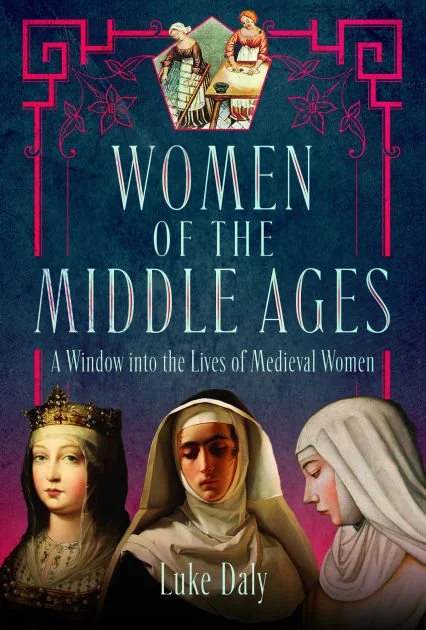
Luke Daly’s Women of the Middle Ages is a brisk, engaging, and quietly radical re‑examination of a world too often filtered through the eyes of men and the stories of the exceptional. Daly’s mission is clear from the outset: to correct the long‑standing imbalance in medieval historiography by shifting attention away from queens, saints, and aristocratic outliers, and toward the ordinary women whose labour, resilience, and ingenuity sustained medieval Europe. It is a book that insists the Middle Ages cannot be understood without them.
What makes Daly’s work stand out is the breadth of his research. He moves confidently through the fields, workshops, kitchens, and marketplaces where most medieval women lived their lives, illuminating the physical and economic labour that underpinned society. Agricultural workers, alewives, midwives, healers, and traders all take their place in a book that refuses to treat them as background figures. Daly’s thematic structure moves through work, religion, community, and cultural expectations and this gives the book a natural rhythm, allowing readers to see how these spheres inherently overlapped and shaped one another.
His chapters on religious life are particularly compelling. Daly explores not only the cloistered world of nuns but also the semi‑independent Beguines and the countless laywomen who sought spiritual refuge outside formal institutions. These sections highlight the diversity of medieval female piety and the ways women carved out intellectual and communal spaces even within restrictive frameworks. The book’s treatment of childbirth and healing is equally striking. Daly approaches these subjects with nuance, acknowledging the dangers and silences surrounding them while foregrounding the expertise of midwives and the networks of female support that made childbirth a profoundly communal experience.
Daly’s prose is lively without being casual, scholarly without being dense and makes for an easy yet incredibly informative read. Writing with the assurance of someone deeply familiar with the archival landscape, Daly is masterful at ensuring the depth of research never overwhelms the reader. Instead, he uses these sources to build a textured, human portrait of medieval womanhood. The result is a book that feels both authoritative without being intimidating, suitable for newcomers to medieval history as well as seasoned enthusiasts.
Daly is also candid about the limitations of the surviving evidence. The poorest women, those least likely to leave written traces, remain the hardest to recover. Rather than ignoring this imbalance, he addresses it directly, using comparative examples and broader social patterns to gesture toward the lives that remain partially obscured. This honesty strengthens the book, grounding it in the realities of medieval documentation while still striving for inclusivity.
Ultimately, Women of the Middle Ages succeeds because Daly never loses sight of his central purpose: to restore visibility to the countless women who shaped medieval life in ways both subtle and profound. By bringing their stories to the forefront, he offers readers not just a survey of medieval womanhood but a reminder of how much of history has been lived in the shadows. Daly’s book brings those shadows into the light with empathy, rigour, and a storyteller’s instinct for the telling detail. It is a welcome and necessary addition to the growing body of work that seeks to rebalance our understanding of the past, and it deserves the praise it has already begun to receive.
Thank you to the author and Pen and Sword Books for allowing us the opportunity to review this book.
You can get your very own copy HERE