

King John and the Fate of his Greatest Knight, William Marshal
Written by Talia Bega
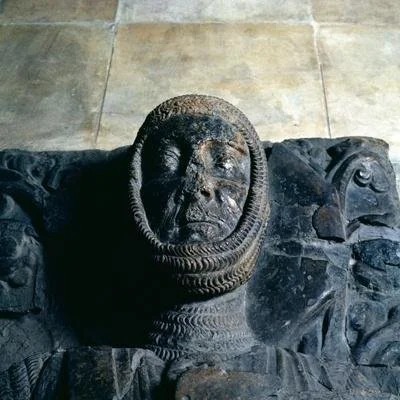
William Marshal’s effigy- Temple Church London
In the 12th century, England was ruled by a powerful dynasty that lasted over three hundred years from 1152 until 1485 and the Battle of Bosworth Field, during which this dynasty fell with the death of King Richard III. It was known as the Plantagenet dynasty that ruled with immense power, vying for control beyond the English borders in France. Henry II was the first king that ruled this dynasty followed by two of his four sons, Richard and John, after his death. Henry was a king that yearned for power and control and expanded an empire known today as the Angevin Empire that covered the vast majority of France. The Plantagenets were not afraid of a family feud, as civil wars between each other grew to such an extent that father and son would fight almost to the death, notably Henry the Young King, the eldest of Henry II. That son in particular was tutored by one powerful figure known as William Marshal, who is one of the greatest knights known in English history. William served Henry II and his sons, and was known for his courage and loyalty. No matter what conflict occurred, William stayed loyal to the sovereign in the purest fashion, as the rebels around would betray those on all sides.
In 1173, Henry the Young King rebelled against his father, Henry II, largely because he had been crowned but given no real authority or lands to rule. The rebellion drew support from his brothers Richard and Geoffrey, as well as their mother, Eleanor of Aquitaine, who was later captured and imprisoned. William Marshal, who served as the Young King’s knight, remained loyal to Henry II during the conflict. The rebellion lasted until 1174, ending with the restoration of Henry II’s authority. William Marshal later became a key figure under King John and played an important role during the political crisis that produced the Magna Carta in 1215, eventually reissuing it as regent for Henry III.
William Marshal (1147–1219) was the son of John Marshal, a minor nobleman and Marshal of England who fought during the civil war known as the Anarchy. William spent part of his childhood moving around England as the conflict unfolded, and at one point he was even held as a hostage by King Stephen. The Anarchy, which lasted from 1135 to 1153, was a civil war over the English crown between King Stephen and Empress Matilda, daughter of Henry I. It ended when Stephen agreed that Matilda’s son, Henry, would succeed him, leading to Henry II’s accession and the start of the Plantagenet dynasty.
William served members of Henry II’s family throughout his life. He was raised for a time in Normandy under William de Tancarville, where he began his training as a knight. His education included training in arms as well as learning Latin prayers and biblical stories. In 1166, William was knighted in Normandy before a campaign in Flanders. At twenty years old, William was ready for the next stage of his career.
In his early years, William attended many tournaments, where he displayed his exceptional skill and won great admiration. These tournaments, including jousts, were major forms of entertainment for nobles and royalty. His success as a fighter, along with his marriage to Isabel de Clare, made him Earl of Pembroke and one of the wealthiest men in the realm.
In 1189, Henry II died at Chinon after being pressured by rebellions led by his sons, Richard and John, with support from Philip II of France. Richard, as the eldest surviving son, became king until his death in 1199, when John succeeded him. There is not much recorded about William’s service under Richard beyond his presence on a few regency councils and time spent managing his estates with his wife.
After Richard’s death, John inherited the Angevin lands, though many soon fell into French hands. In 1200, the Treaty of Le Goulet confirmed John as king in a settlement with Philip II, despite the rival claim of Arthur, Duke of Brittany, the son of John’s late brother Geoffrey. The conflict ended with Arthur’s disappearance in 1203, widely believed to have been caused by John, though the details remain uncertain. William supported John, as Arthur’s claim was disputed.
Tensions grew as war broke out again between John and Philip II, with Normandy becoming the main battleground. William remained loyal to John, though the king’s leadership was often poor. John won a notable victory at the Battle of Mirebeau in 1202, but the fall of Château Gaillard in 1204 led to the loss of Normandy. William proved himself a capable commander, but John’s failures placed his supporters in difficult positions. The loss of Normandy was a major blow to the dynasty and raised questions about John’s ability to rule.
William faced further challenges when he paid homage to Philip II for his Norman lands, which angered John. In 1207, conflict spread to Ireland, where William’s lands were attacked by the justiciar. John also harassed William at court during this period, even as the king faced excommunication in 1209 over a dispute with the pope regarding the archbishopric of Canterbury. William, now in his early sixties, found himself navigating a tense political climate. Despite John’s increasing hostility toward many nobles, William did not rebel, and by 1212 relations between them had improved.
In 1215, the English barons rose against John and forced him to accept the Magna Carta at Runnymede on June 15. The charter’s 63 clauses limited royal power in matters such as taxation and justice. While the document has become foundational to modern constitutional government, at the time it sparked further conflict. Prince Louis of France launched an invasion of England, beginning the First Barons’ War. Many barons joined Louis, but William remained loyal to John. He understood that switching sides could destroy his reputation for loyalty, which had defined his career.
The war began with the Siege of Dover and continued as more rebels rallied against the king. John died in 1216, leaving the throne to his nine‑year‑old son, Henry III. William was appointed regent and guided the kingdom through the final stages of the conflict. He reissued the Magna Carta and restored stability before his death in 1219. On his deathbed, William took the vows of a Templar, with his wife and family at his side, ending his life as one of the most respected knights of his age.
William’s loyalty remained constant throughout his life. From the struggles of Henry II and his sons to the crises of John’s reign and the rise of French power, William stood firm in his duties as a knight and leader. His reputation for honor, courage, and steadfastness shaped his legacy and secured his place as one of the greatest figures of medieval England.